China has become a major manufacturing base for industrial measurement equipment, including the Water Pressure Gauge sector. Its advantages include broad metalworking capacity, mature machining clusters, and increasingly automated calibration facilities. However, low price alone does not prove reliable performance.
Industry reports provide useful context. MarketsandMarkets’ recent pressure sensor market analysis identifies water management, process control, and industrial automation as important demand areas. Grand View Research also highlights rising investment in water infrastructure and monitoring systems. These reports do not rank individual Chinese manufacturers, but they explain why demand for accurate pressure measurement continues to grow.
This guide examines ten notable China-based Water Pressure Gauge manufacturers through practical purchasing criteria. These include measurement range, accuracy class, wetted materials, thread standards, ingress protection, calibration records, and after-sales support. Product photographs can show a polished dial. They cannot confirm long-term stability.
Relevant benchmarks include ASME B40.100 and EN 837-1, where applicable. ISO 9001 certification may indicate controlled processes, but it does not automatically guarantee gauge accuracy. Independent calibration evidence matters more.
Field experience often reveals small differences. A gauge installed beside a vibrating pump needs stronger movement protection. A corrosive water line may require stainless steel wetted parts. A municipal pipeline may prioritize clear readings and easy replacement.
The ranking is not absolute. Supplier capabilities change, and catalog information can become outdated. Buyers should verify current certificates, sample performance, production lead times, and reference projects before placing an order. Some manufacturers communicate well but provide limited technical evidence. That deserves careful review.
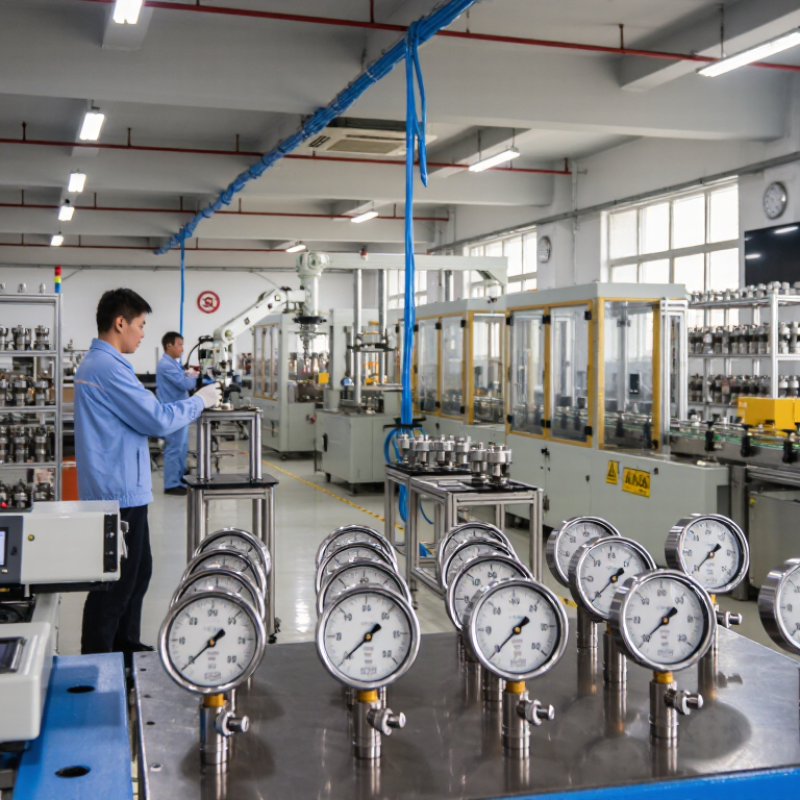
A high-quality water pressure gauge manufacturer proves performance, not just appearance. The case should resist corrosion, the dial should remain readable in dim plant rooms, and the wetted parts should suit the water chemistry. A steady pointer matters. So does repeatable calibration. Buyers should request accuracy specifications, pressure-cycle test results, and traceable calibration records. ASME B40.100 provides industry guidance for pressure gauges, including accuracy, testing, and installation. ISO/IEC 17025 sets requirements for competent testing and calibration laboratories. These references help buyers assess evidence rather than rely on polished product claims.
Reliability also depends on the application. A gauge used on a building water line faces different vibration, temperature, and pressure spikes from one fitted to a pump station. The WHO/UNICEF Joint Monitoring Programme reported that 2.2 billion people lacked safely managed drinking water in 2022; dependable monitoring is one small part of resilient water systems. A capable manufacturer should explain gauge selection, connection options, overpressure limits, and maintenance intervals in plain language. Ask how readings are checked after repeated pressure cycles. One caveat: even a well-made gauge can mislead when installed poorly. I would still want clearer field-service data from many suppliers.
A credible ranking should measure performance, not factory size or online visibility. The World Health Organization and UNICEF Joint Monitoring Programme reported that 2.2 billion people lacked safely managed drinking water in 2022. This highlights the need for dependable pressure measurement in treatment, pumping, and distribution systems. However, demand alone cannot prove manufacturing quality.
I would assign 30% to measurement accuracy and repeatability, verified through traceable calibration records. Give 20% to materials, including corrosion-resistant wetted parts and clear dial protection. Production consistency deserves 15%, supported by inspection records and batch sampling.
The remaining score can cover delivery reliability, technical support, warranty handling, and export documentation. ISO 5171 provides a useful reference for pressure-gauge construction and testing, while ISO 9001 certification can support process control. It cannot replace product testing.
Ask for real evidence. A serious supplier should provide calibration certificates, leak-test results, temperature ranges, and failure data from field use. Check whether a 0–1.6 MPa gauge remains readable after vibration and repeated pressure cycles.
Small details matter. Needle stability matters.
A ranking also needs independent verification. Factory audits, sample testing, and customer interviews should carry more weight than promotional claims. The World Bank’s water infrastructure reports repeatedly link service reliability with effective maintenance, yet many rankings ignore after-sales response. That is a weakness. My own scorecard would also record unresolved complaints and delayed corrective actions. No method is perfect. A low-cost gauge may pass laboratory checks but perform poorly in humid pump rooms. Real operating conditions should decide the final order.
China’s top ten water pressure gauge manufacturers serve residential, industrial, agricultural, and municipal water systems. Their products commonly include brass, stainless steel, and plastic cases. Many offer dial sizes from 40 to 100 millimeters, with pressure ranges selected for clean water, pumps, boilers, and filtration equipment.
In practical purchasing work, I check more than catalog prices. A reliable manufacturer should provide calibration records, clear accuracy ratings, and stable readings after repeated pressure cycles. Thread standards also matter. G1/4, G1/2, and NPT connections must match the installation site. Some factories support glycerin-filled gauges for reducing pointer vibration. Others provide custom scales, rear connections, or protective covers. Useful details.
The strongest manufacturers usually maintain documented production controls and traceable testing equipment. Look for material certificates, leak tests, temperature data, and sample inspection reports. Export experience can also reveal how carefully a supplier handles packaging and technical documents. A damaged gauge is not a small problem on a remote site.
However, any “top ten” ranking requires caution. Factory capability can change with suppliers, staff, and order volume. Online claims may sound impressive but remain difficult to verify. I would request samples and compare readings against a certified reference gauge before placing a large order. One weakness remains: some manufacturers explain accuracy well but provide limited long-term field data. That gap deserves attention.
China Top 10 Water Pressure Gauge Manufacturers: Products, Certifications, and Customization Capabilities Compared
A serious comparison should examine more than price and production volume. Leading Chinese manufacturers commonly supply dry, liquid-filled, digital, and diaphragm water pressure gauges. Typical ranges cover domestic water systems, pumps, filtration units, and industrial pipelines. Stainless steel cases resist moisture better, while brass connections suit many general applications. Accuracy may vary from 1.0% to 2.5% of full scale, so buyers should request test records.
Certifications help establish reliability, but they need careful checking. ISO 9001 indicates a quality management system, not automatic product accuracy. Depending on the destination, buyers may also need CE, RoHS, EN 837, or pressure equipment compliance. Certificates should match the exact model, factory, and production date. A certificate copied from another product is a warning sign. I have seen specifications look impressive until the connection thread differed from the installation drawing.
Tips: Confirm pressure range, thread standard, dial size, wetted materials, and operating temperature before ordering. Ask for calibration data from recent batches. For outdoor use, check ingress protection and case sealing. Custom options can include dual scales, special dials, silicone filling, alarm contacts, logos, and redesigned connectors. Request a sample first. Small details matter.
Rather than assigning unverified scores to manufacturers, this chart compares commonly specified pressure-gauge accuracy classes with their corresponding maximum permissible error as a percentage of span. These product specifications can help buyers assess and compare supplier offerings; certification and customization options should be confirmed with each supplier.
Choosing a Chinese water pressure gauge supplier starts with the measurement conditions, not the catalogue price. Define the pressure range, connection size, wetted materials, temperature, and whether the gauge will face vibration or water hammer. For a pump room, a stainless-steel case and a readable dial can matter more than a small unit-price saving. Ask for the accuracy class, calibration method, and a sample calibration certificate. Check that the stated test points cover the range you will actually use.
Water-system losses make reliable readings consequential. The World Bank’s 2006 report, The Challenge of Reducing Non-Revenue Water in Developing Countries, estimated that utilities in developing countries lose about 35% of supplied water as non-revenue water. That figure is not a gauge-performance measure, but it shows why dependable monitoring matters.
Request traceable calibration records and confirm whether calibration is performed by a laboratory accredited to ISO/IEC 17025. Also inspect thread and flange specifications, overpressure limits, and packaging protection. Ask for production lead times and batch inspection records in writing. Small details count. A supplier may provide a polished sample yet vary across production batches; verify with a pre-shipment inspection or a trial order. Don’t treat a certificate as proof that every unit is consistent.
Measurement accuracy and repeatability should carry the greatest weight. Check traceable calibration records and repeated readings across the stated pressure range. Factory size alone proves little.
Ask for calibration certificates, leak-test results, temperature limits, and batch inspection records. Request them before placing an order. Paperwork still needs checking.
Define the pressure range, connection size, temperature, and expected vibration. A stainless-steel case may suit a damp room. Check that the dial stays readable.
Wetted parts need suitable corrosion resistance for the water and operating conditions. Confirm thread or flange dimensions before ordering. Small mismatches cause delays.
Compare multiple samples, not just the polished sample provided for review. A trial order or pre-shipment inspection can reveal batch variation. One sample is not enough.
No. A quality-management certificate can support process control, but it does not replace product testing. Ask for test results on the gauges themselves.
Ask whether a gauge in the 0–1.6 MPa range remains readable after vibration and repeated pressure cycles. Also check overpressure limits. Field conditions can surprise you.
Record delivery delays, response times, unresolved complaints, and corrective actions. A low-cost gauge may pass laboratory checks yet struggle in a humid pump room. I might give service too much weight, but ignoring it seems worse.
This article provides a practical guide to identifying China’s leading Water Pressure Gauge manufacturers and understanding what separates reliable suppliers from average producers. It explains the key qualities of a high-quality manufacturer, including product accuracy, durability, stable production capacity, strict quality control, responsive service, and experience serving different industrial applications. It also introduces a clear ranking approach based on manufacturing expertise, technical development, certifications, product consistency, customization support, delivery performance, and customer communication.
The comparison further examines product ranges, certification capabilities, materials, connection options, pressure ranges, dial designs, and OEM or ODM services. Finally, the article offers useful advice for selecting the right Chinese supplier by evaluating technical requirements, inspection procedures, production capacity, sample quality, pricing transparency, lead times, after-sales support, and long-term cooperation potential. This framework can help buyers make informed decisions and choose a supplier that matches their application, budget, and quality expectations.

Accuracy Instrument